

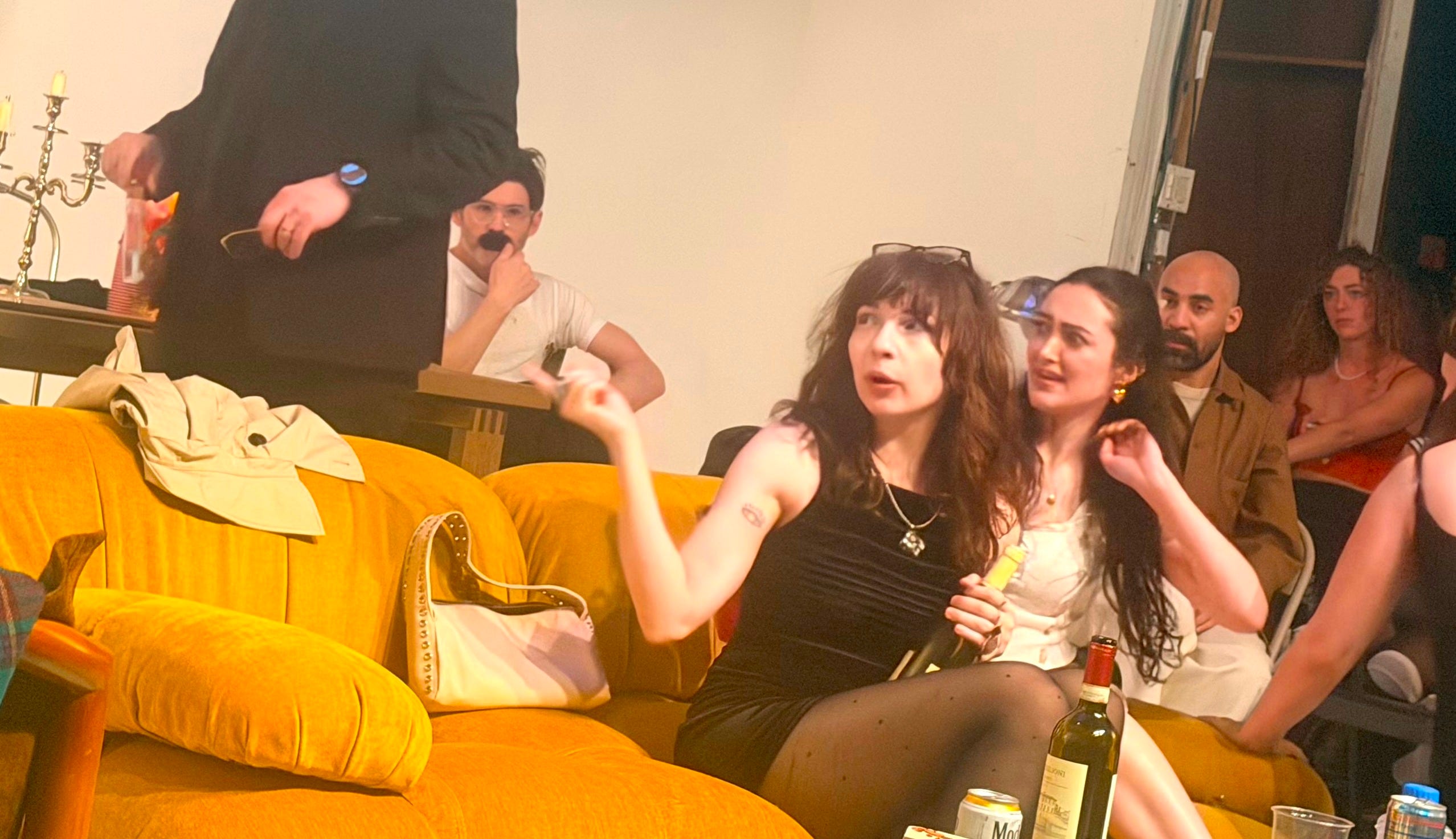
I was late to see The Last Days of Downtown and called it fashionable.
It was the third and final installment of the downtown trilogy by Matthew Gasda, the playwright behind Dimes Square. He wrote the original play the scene took its name from and forgot to credit along the way. As a Cultural Anthropologist, my work extends to subcultures. My relationship to Dimes Square was that of a subculture ethnographer. Before hitting submit on my final scene report, I realized I’d skipped the one move you do not skip: tracing the origin point. You do not write about a subculture without getting to its roots.
Now, some of you reading this may think Dimes Square is:
Some evil Peter Thiel psyop
Mid-tier entertainment for insecure upstarts
A cluster of “dissident art hoes” orbiting the Red Scare cinematic universe
Literally just me and my friends hanging out
An overpriced neighborhood for trust fund kids playing bohemian
Nothing at all. Why am I reading about this NYC art world minutia? Unsubscribe, bitch!
Controlled Jewish opposition for the Right
Already dead
All of these interpretations are simultaneously right and wrong, except for the Jewish one, because Dimes Square became leftist the minute it got funded. (you’ll understand more about this in my final scene report) Yet its roots are undeniably theatrical, which perhaps gives the Jewish interpretation its own legitimacy. The origins of this particular scene trace back to theater, and Gasda is an independent playwright whose own Substack is worth checking out. I decided I wanted people to understand the roots of Dimes Square before I let my personal record go to the press, so I attended a viewing of The Last Days of Downtown and interviewed Matthew Gasda to do my diligence.
I needed people to know that the Gasda play was how all this Dimes Square insanity started. The record is always rewritten by people who show up to the afterparty and start taking credit for the origin story, rather than admitting that they’re subculture ethnographers two days before they drop their own obituaries. Dimes Square was the first in the trilogy, Gasda told me. The second was Afters. The third one, and the final one, was The Last Days of Downtown. I had an interview lined up with him after the play was over, but first I had to survive watching it. Could I manage?
Not exactly. The guy I was supposed to go with cancelled last minute due to some weird drug episode, peak Dimes Square subculture behavior, so I ended up going alone and got lost on a route I had already taken. The Center For Theatre Research in Williamsburg was hidden inside an apartment building, with almost no indication of where the entrance actually was. I wandered through hallways and stairwells convinced I had accidentally walked backstage. At one point, I thought I may have wandered onto the set. By the time I finally found my way in, it was at the end of Act One.
I wanted the late entrance to look like a part of my act, yet there were people’s grandparents in the audience, so I had to compose myself and take off my persona. This was not going to be petty. It wasn’t even going to be downtown. (it was Williamsburg) The staff were kind enough to guide me in despite my dramatic arrival, and an audience member silently pointed toward a seat he had pulled out for me as I slipped into the theater space. The gesture felt strangely ceremonial.
As I began getting cozy, the first thing that hit me was Sartre's No Exit. This was No Exit for hipsters. The set was a downtown apartment living room, the actors looping through conversations that were banal and profound at the same time. What if a handful of exaggerated archetypes were trapped in Hell together? There were references to generational stagnation, social media posturing, unintentional performance art, and the surveillance gaze of your own social group. Hell is other people, and all of them are online. Hell is being seen. Hell is the audience you’ve built.
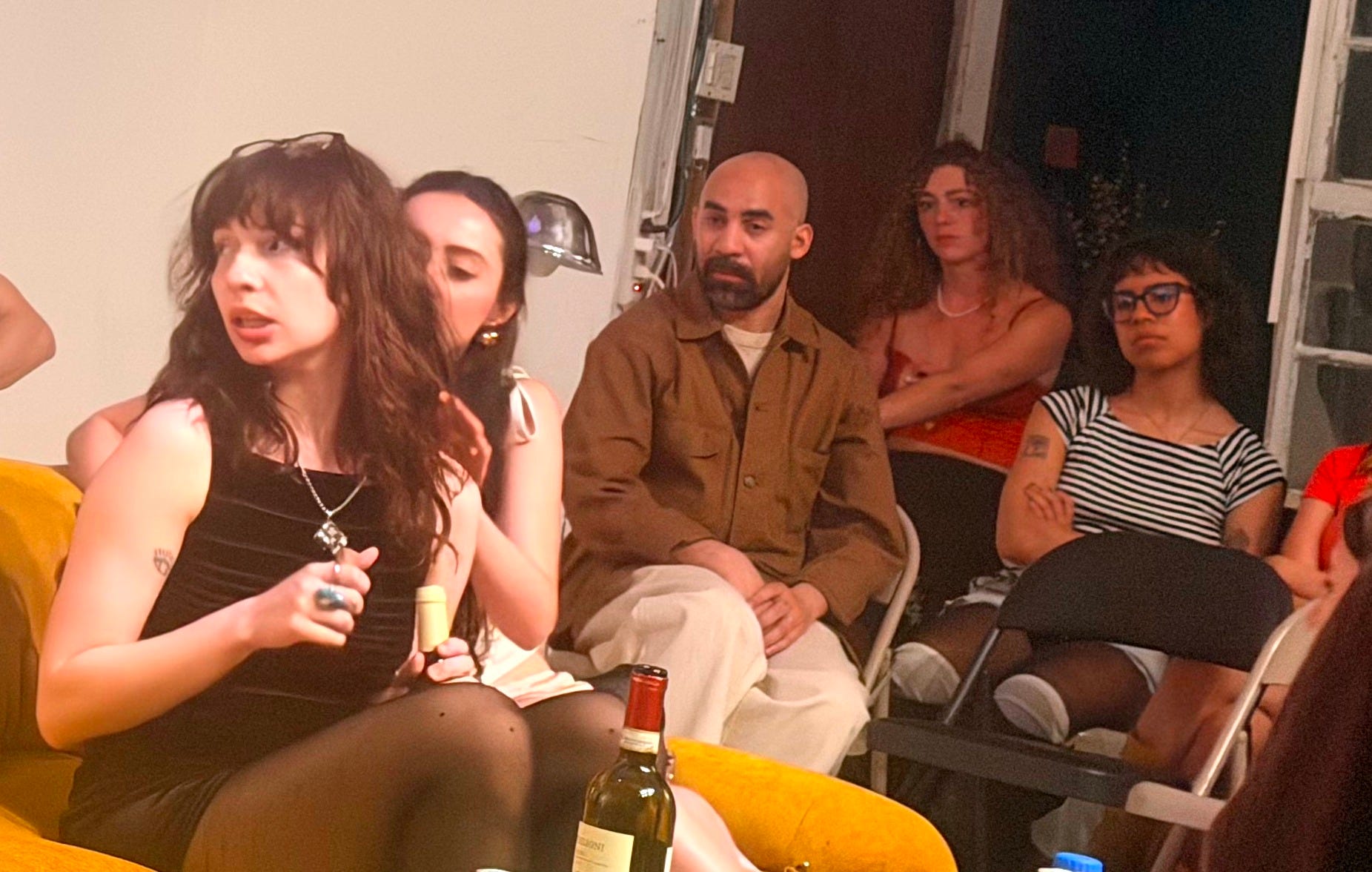
As Act One closed, about five minutes after I sat down, the couple behind me began chattering at full conversational volume about how one of their friends had just turned up on the Epstein list. It was casual cocktail-hour discussion. I realized it was perfect, because it matched the decadence Gasda had been mapping this entire time. The play extended past the stage and the audience was inside of it. The Epstein-list reveal was an atmospheric humble brag.
Closing Night for the Scene
I wandered through intermission and talked to random people. I was relieved that nobody recognized me. I was just at a play conducting an interview, right? Not exactly. I felt “inside the play” during the intermission too and I think that was the point. We were the last days of downtown. This intermission was part of something that hadn’t been mentioned, and I loved its perverse orchestration. The crowd was unfamiliar in a clarifying way, actual theater people, there for the work and not for the selfie. One guy managed a portfolio of cancelled and controversial personalities. He carried himself with real gravitas, so I naturally spoke with him first. Yet Gasda didn’t seem controversial at all.
Act Two is where it cracked open. Gasda had built a trilogy out of the banality of his own social scene, and beneath the superficial cruelty and the constant self-referencing, the people on stage were insecure and human and alive. Even at their most cartoonish, (the jaded millennial hipster being my favorite archetype for obvious reasons) they were profoundly flawed people. Just people. People talking about their social lives, fears, and emotions onstage. People making internet era inside jokes onstage. People name-dropping downtown venues onstage. People doing lines of cocaine onstage. I don’t think it was real cocaine?
The dominant theme, Gasda confirmed with me later, was peer surveillance as the operating condition of modern artist life. How do you live when the whole world is watching, when your whole world is the same forty people?
Aesthetic Hierarchy
The acting was convincing, though some of these characters may have been playing themselves, so I’m not sure how much of a stretch occurred. I was there, mourning the death of the scene alongside people whose lives were not quite like my own, many whom I believe to be funded at least partially by their parents. Yet I was still along for the ride. I laughed out loud when an actor said “aesthetic hierarchy” because that’s exactly how we talk to each other now. Gasda was the guy who had thought to put it onstage.
That moment was when it all came into focus for me. He had been sidelined by the clout-chasers, which is exactly what I had suspected from the beginning. He was a genuine person writing genuine work about his own social scene from a critical lens, putting it all onstage in its naked and uncomfortable form. He was never named in the Dimes Square hit pieces, even though the micro-verse spun out of this theatrical critique of his own circle.
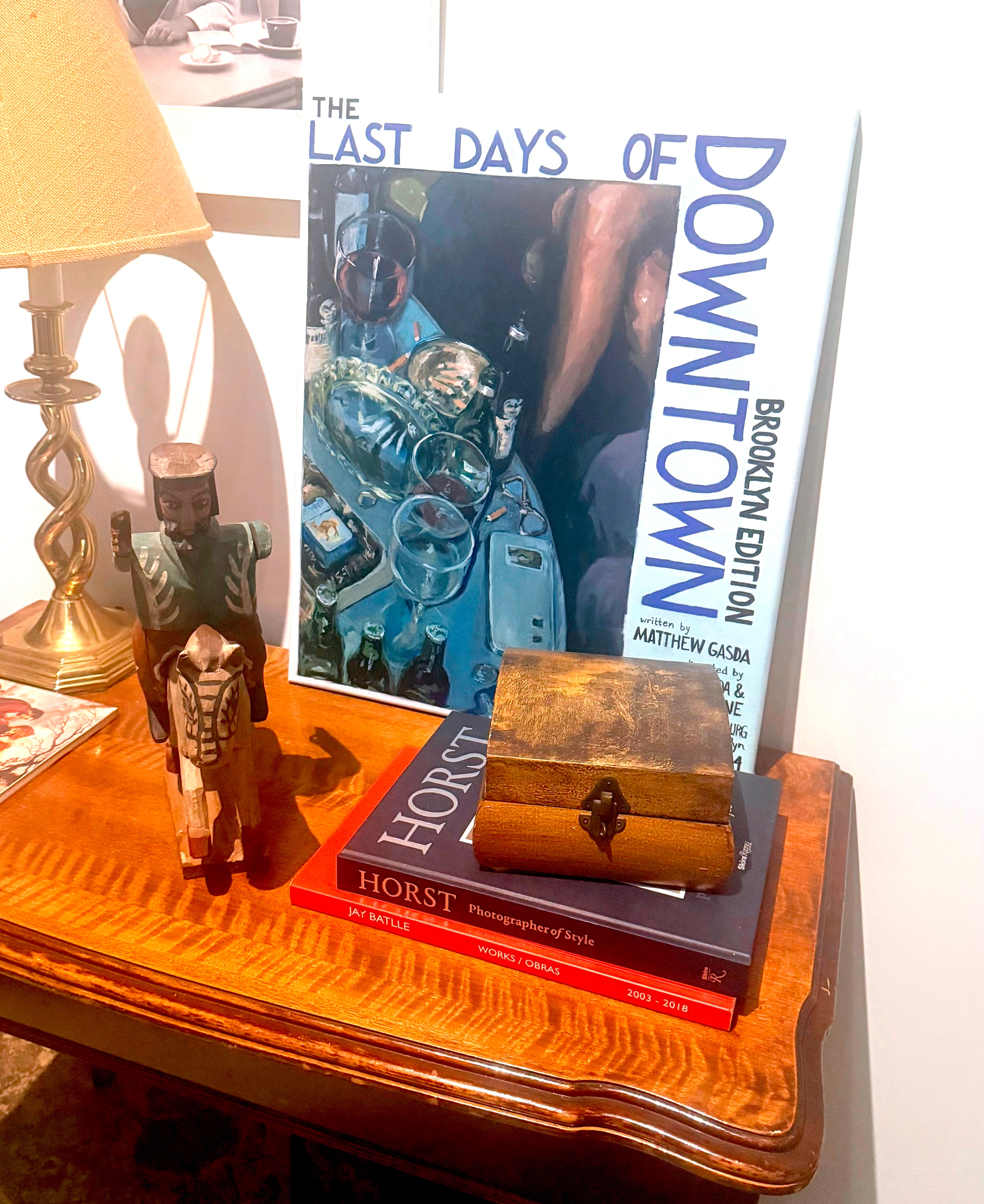
My Interview with Matthew Gasda
Rachel Haywire:
My first question for you is about the characters. Are they based on real friends of yours or general archetypes drawn from the Dimes Square scene?
Matthew Gasda:
Drawn from is better than based on. Nobody’s specifically modeled after one real person, but there’s definitely material pulled from the general population of Dimes Square. The characters are inventions. They’re vehicles for the actors. I don’t want anyone coming to the play thinking, that’s exactly me. Someone might recognize certain energies or behaviors, but it’s not documentary theater at all.
RH:
I never saw the original Dimes Square play, but am I right in assuming this is the final play with these characters?
MG:
Yeah. This is the third play. The second was called Afters, and this is The Last Days of Downtown. It’s definitely the end. These characters won’t appear on stage again.
RH:
So the title is literal?
MG:
Yes, this is the last time I’m going to do this story.
RH:
Were there any playwrights that inspired you for all of this, or was it exclusively inspired by your social surroundings?
MG:
For this play, it’s mostly self-referential. I was responding to the first two plays in the sequence. In a lot of ways, it’s a derivation of the original Dimes Square play. It keeps the same structure of rotating characters, fragmented narratives, no single protagonist, and a kind of second-act novelist energy. I wanted it to stay formally connected to the original.
RH:
Here’s my big question. There are obvious references to the current era, but it also feels timeless, like this story could’ve happened in almost any incarnation of New York. The scenes of the city keep repeating the same social patterns in different forms. Do you think this is just another cycle, or is there something uniquely different about this era?
MG:
I think ultimately it’s the same dynamics. What’s unique is the surveillance. It’s the anxiety about being watched. Artists have to live under constant surveillance by their peers.
RH:
Like the Factory era but with digital paranoia?
MG:
Exactly. Andy Warhol famously documented everyone around him, but it wasn’t threatening in the same way. Now the surveillance feels more ominous. It stands out as a unique trait.
RH:
So that’s the defining trait of this era?
MG:
That’s the thing that makes this period distinct.
RH:
Is it possible to be an active person in this type of scene without burning out when toxic people attach themselves to you?
MG:
No. Definitely, no. You want to quit.
RH:
Have you ever considered moving into mainstream theater, or do you think your inside references are too alienating for that type of audience?
MG:
Mainstream theater hates me. They would never let me do this kind of work. They don’t like me, and they don’t like my content. They don’t like the fact that I built something outside of their institutions, because it shines light on how dull those institutions have become.
RH:
Do you think it’s a lack of connections, or is it something more ideological?
MG:
They genuinely dislike me and what I represent. I really can’t stress enough how much mainstream theater dislikes me.
RH:
Is there hope for a new independent theater scene in New York City now? Will it happen?
MG:
You’re looking at it.

If you like what I’m doing here at The Cultural Futurist, don’t forget to buy me a coffee.

Wow. This is really good. Thanks for this!