I Was a Teenage Diner Goth
The Taxonomy of Someone Else's Subculture
Everyone is talking about Diner Goth on Twitter, the platform I’m not supposed to be on. They won’t stop sending me this article, so I’m in a difficult position. See, I’m reinventing myself and dropping the scene persona. I’m a serious fascism instructor who is building a new institution. I’m writing one final scene report on Dimes Square before I officially become an adult in the room. I can’t be seen posting to Elon’s timeline or my reputation will be ruined. I’m back on Substack now, where people have never even heard of looksmaxxing. They just make puns about it.
Yet Robert Mariani, a name I haven’t heard in a while, went viral with this piece he wrote for The New Atlantis on the phenomena he calls “Diner Goth.” This is essentially a term he coined to describe the downward mobility of alternative subcultures. I do feel the need to say something here. Mariani has given a name to something I’ve been witnessing in real time for fifteen years. He calls it Diner Goth and defines it with the precision of someone who arrived on the scene a decade after it ended. Yet he’s not entirely wrong.
He hands you “diner” for provincialism and “goth” as shorthand for alternative aesthetics. Mariani’s lane is building an AI dating app, which aligns him with the cohort of NRx posters who didn’t make the next funding round and pivoted to cultural criticism. Well, Cultural Anthropology has one rule that these journalists keep forgetting: know the culture you’re anthropologizing. We want to know if you were there. Were you?
Am I really doing material analysis in 2026?
The story goes like this. There were very few genuinely alternative people left in cities that could afford to be genuinely alternative. The ones who remained either had roommates stacked deep in Bushwick or family money they didn’t talk about. Perhaps they made it into the mainstream economy that slowly removed the edges that made them “alternative.”
What Mariani is documenting in his Wisconsin CVS trips and Portland Tinder dates is not some new subculture that’s spontaneously generating itself in the provinces. It’s an old subculture, redistributed downward by economic pressure, decanted into places where the rent is cheap and the roads are broken. It’s aesthetically grotesque, he notes. The Hills Have Eyes material. Well, its queer anti-intellectualism is what happens when you sever a subculture from the cities and strand it in places where development was never an option.
The kid who may have moved to New York at 22 and found his people in Alphabet City now stays in a mid-size town and builds his identity on Discord. He can no longer move into the Hotel Chelsea to find the others. This is the demographic displacement that racialists have been talking about for so long, even if their politics are at war with this latest cadre of Diner Goths. Those being displaced will never admit this, but that’s a topic for another essay. I’m not feeling a particular desire to air that grievance right now. No, I’m doing a material analysis on Diner Goth in 2026, which is somehow even more vanguard.
If we really want to break things down as deconstructionists, we can think about The Literal. Think, for a moment, about what all smalls towns have in common. Take a wild guess. You’re probably beginning to figure it out now. Everything except for the dive bars shuts down by 8PM with one notable exception: The Diners.
Nothing Else was Open
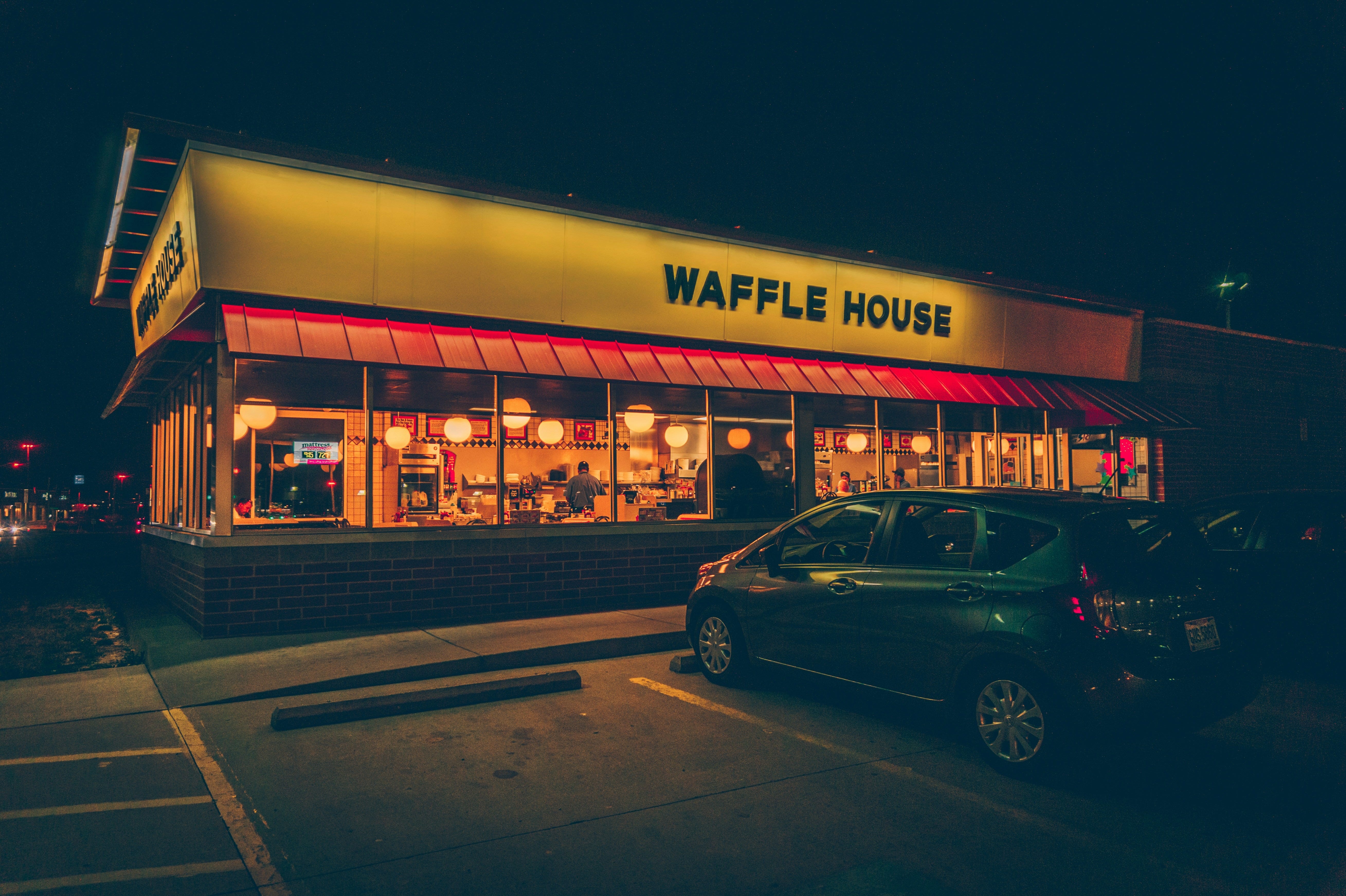
Here are some footnotes that the faculty lounge is afraid to cite. I want to the Savannah College of Art and Design (SCAD) in Savannah, Georgia. It was a beautiful historical postcard of a town with its Spanish moss, cobblestones, and preservation ordinance that froze time. You would fall into its capsule or go insane, sometimes both. We hung out at diners before Discord had been invented. Why diners? Nothing else was open. That's the origin story. I remember outsider students and townies pulling out their sketchbooks at the Waffle House and showing me what I’d now describe as prison-esque sketch art. They’d read me their schizophrenic poetry with the fervor of dictators trapped on platforms without an audience.
I remember thinking: how do I organize this into a live performance and get it to Atlanta? Atlanta was the answer. Atlanta was always the answer back then. As a Graphic Design major, I was focused on business. What else can you focus on in a small town? I may have changed my SCAD major to Business later on, but I honestly don’t remember. Was that how I became an entrepreneur? When there’s raw material you want to get it somewhere with infrastructure. That’s precisely what these Diner Goth subjects are missing: infrastructure.

Now Atlanta has gutted itself. Portland is a punchline that stopped being funny after its show aired one too many times. The Diner Goth can’t get out, and there’s nowhere left to go. I was there when Diner Goth started. It felt like I was an art school student in a tourist trap. I thought I was the only artist hanging out with the local biker gang, but the biker gang went to the same parties as the students, and that was just small town physics. Everyone orbits the same three venues until somebody leaves or dies. I was a teenage Diner Goth.
There was Tybee Island. It was Savannah's resort-town cousin, a barrier island thirteen miles east where the real estate was owned by people who did weekends and the residents were a different species. Picture it like this: you're at a Tybee Island house party. Invite-only, but everyone you know is there because the invite list is everyone. Black men with muscle make semi-intellectual arguments about how slavery is dignified. White liberal dominatrix girls with septum piercings explain their strategies to pay film school tuition. It's normal. This is normal. Savannah and Tybee Island are having a normal one, and what you're witnessing is proto-Diner Goth.


The Subculture Downmarket
Mariani documents a copy, and to some people the copy is genuinely interesting and/or repulsive, whether it’s the furry CVS assistant manager or the Amazon fulfillment center streamer who dreams of voice acting while doing shows on OnlyFans. Yet Mariani mistakes the symptom for the disease and the copy for the subculture. He discovers that alternative aesthetics have gone downmarket and writes a feature-length sociology essay about it. The more interesting question is this: why did they go downmarket, and what was the cost?
This is an American story about class.
I’d been asking for years why all the goth women disappeared from New York and San Francisco, and my answer was usually that they had been replaced by immigrants or trad influencers. Neither of these answers seemed to satisfy anyone because they appeared reactive or maybe just radioactive. What Mariani is describing is very real. It’s too real. The neurodivergence is real. The longing is real. The sadness is real. It’s what happens when people who don’t fit their conservative small-town backgrounds have nowhere else to go. It’s when the aesthetic of alienation becomes the aesthetic of immobility, performative or not.


Can these towns be fixed? Has Mariani lived their realities or is he just a downwardly mobile techie in Portland? Giant among the swine, right? Yet I can relate, except that I would never do journalism on it. Not until now, I mean. Have I become one of them? As an adult I was holed up in Jacksonville for almost a year after needing to, let’s just say, cut some corners. Jacksonville is a town in Florida that makes Savannah seem like Los Angeles. I was working a middle class job at a Republican propaganda outlet while producing tiny art and music events that made the city a catalyst for a place that existed in my mind. Nobody knew who I was online. Nobody cared. They only wanted my Discord handle.
The thing about “making a town better” is that the town’s daily life goes completely unchanged. The people you’re trying to “enrich” still go home to the same despair. They don’t have access to the cities where a career in a creative field is possible, where the feedback loops exist, and where you can network your way to social capital. The townie suspicion of the cultural organizer is class-correct. They know you’re practicing on them. They know this city is your experiment and not your home. They’ve seen it all before and they’ll see it all again. They hate you.
Goth and its Glamorous History
What frustrates me the most about “Diner Goth” is the implication, never quite stated but present throughout, that this is simply what goth is now. Provincial, downwardly mobile, and prole-ified. It’s traced with sympathy and a certain sociological affection, accepting of the declassing as a given, inevitable, current state of things. It’s a blackpill, yet it never had to be.
The alternative subcultures I worked with in my youth were not déclassé when I became alternative professional, yet so what if they were? They were expressive. They were transgressive in ways that required investment in craft and aesthetic development. Alexander McQueen was goth. Vivienne Westwood was goth. There is an entire tradition of dark aesthetics as high fashion, glam, and luxurious provocation that gets completely erased when we accept the Amazon warehouse as its natural habitat. I wrote about this for Evie Magazine last year.


Mariani was born after the subculture he’s describing, using a template that already existed in a more mature form. The goth clubs of the ‘80s. The fashion world of the ‘90s. Even in the NYC of today there are well-off alternative models, actors, and fashion designers. Fewer than ever, sure, but they’re present. I spent years assuming it was a simple story of who was replacing who in the cultural ecosystem. I’m now convinced it actually might be class. Diner Goth has me introspecting.
The post-COVID landscape gave us trad influencers rather than a genuinely creative subculture, because genuine creativity requires room to fail that people can no longer afford. Being into dark aesthetics is not compatible with the current economic landscape. Free expression is now costly in the most literal sense. We fixed cancel culture only to get zombie culture.
Feeing Dizzy Yet?
There’s a vertigo that comes from realizing that what you thought was a creative subculture was simultaneously a socioeconomic condition. That the people you were hanging around with were united less by a shared aesthetic vision than a shared economic ceiling. This whole time I thought I was engaging with a creative subculture when I was really just hanging out with poor people isn’t exactly the coming-of-age story I was hoping to read about Gen Z. It’s an honest one, and I want to give Mariani that. Yet is it the only one? Clearly not.
He finishes his article with some boardroom pandering about the Internet as the new myth, fandom as the soul, and Discord as community for people the economy has left stranded in America. He gets boring here. He’s doing nostalgia he never was around for while highlighting a coping mechanism as a cultural milestone.
I’ll say it again: trad influencer is merely the new goth. The trad aesthetic that swept through cities like New York after COVID has the same longing for structure, beauty, and belonging that goth always did. It’s just inverted in sunlight instead of darkness. Both were responses to economic collapse, and both were reactions to what people did when the future shut down and we wore costumes to play inside the ruins.
The question worth asking, and the question Mariani circles without landing, is whether we can build something that doesn’t accept the ruins as permanent. Can dark aesthetics be reclaimed from the fulfillment center and returned to the vault? Can doing alternative culture become affordable again, or will we spend the next decade writing elegies for subcultures that become mass aesthetics for vape shops?
Only time will tell.


There's certainly something to the thought that the having a place for the nightwalker lifestyle enables some of the subculture. There was a period - perhaps the late nineties and early oughts - when you could find a lot of places open twenty-four hours, not just Dennys but even Home Depot and the like; the thought that the "city that never sleeps" wasn't just a New York or Tokyo vibe but a buzz of (post)modern life was somehow exhilarating. And then somehow that all reversed and everything started closing early again, whether because the economic boom wore off or because the nannies took over or just nobody but Walter White's crowd actually wanted to buy power tools at 3 AM. It's very cyclical - a few years later, it was hard to find a 24-hour pharmacy or even grocery store without driving halfway across the city, and your local 7-11 might close the same time as the local bar. Now it seems to be opening up for later night again, and we have 24-hour fitness clubs and some 24-hour restaurants. I haven't exactly mapped out the demographics of who attends at what hours - and I'm sure that's going to be at least as regionally dependent (and age-bracket-dependent), but the colorful adornments from hair to jewelry to other body art have definitely mainstreamed.
Diners and subcultures go hand in hand , hence the infamous "Rock 'n' Roll Denny's", Canters and Ben Frank's. All were go-to spots after whatever club you were at closed.